Use AI with customer interviews, not instead of them
Ask an AI to play your ideal customer and it can answer fluently, agree with your roadmap and never cancel a call. That is useful for writing better questions. It is not evidence of what customers think. Stamp each line in your research doc with where it came from, then take the simulated ones to real interviews.

What you'll make
a research doc where every line carries one of three provenance labels, a short set of interview questions and a validation plan that turns each simulated hypothesis into a question for real customers.
What you'll need
a work AI account (ChatGPT, Claude, Gemini or Copilot all suit this text method), a product question you are trying to answer, and, if you have them, interview notes you are permitted to use in that account. Allow about 20 minutes for the first question set and label scheme; real interviews take additional time. You can start with no interviews at all, which is often when a persona looks tempting.
Example result — an entry from the fictional research below.
[SIMULATED BY AI] Route planning is the biggest headache.
[HEARD IN AN INTERVIEW] C2, 4 Sept: "Routes are fine, I know the area."
[ORGANISED BY AI] Disruption from last-minute staffing changes (C1, C3) or client
rescheduling (C2); checked against each participant's notes.
Status: not supported by these three interviews; C2 contradicts it.
Next question: tell me about the last time the day's plan changed.
An AI persona is a model playing a customer. It produces plausible answers based on patterns in text, plus whatever you told it about your market. It has never bought your product, missed a deadline because of it or explained the problem to a colleague. Its answers can still help you think. They cannot tell you what your customers think, because no customer was involved.
Where to do this
| Tool | How to use this text method |
|---|---|
| ChatGPT | Paste the research question or the notes you may use into a chat. |
| Claude | Paste the research question or the notes you may use into a chat. |
| Copilot | Paste the research question or the notes you may use into a chat. |
| Gemini | Paste the research question or the notes you may use into a chat. |
1. Learn the three labels
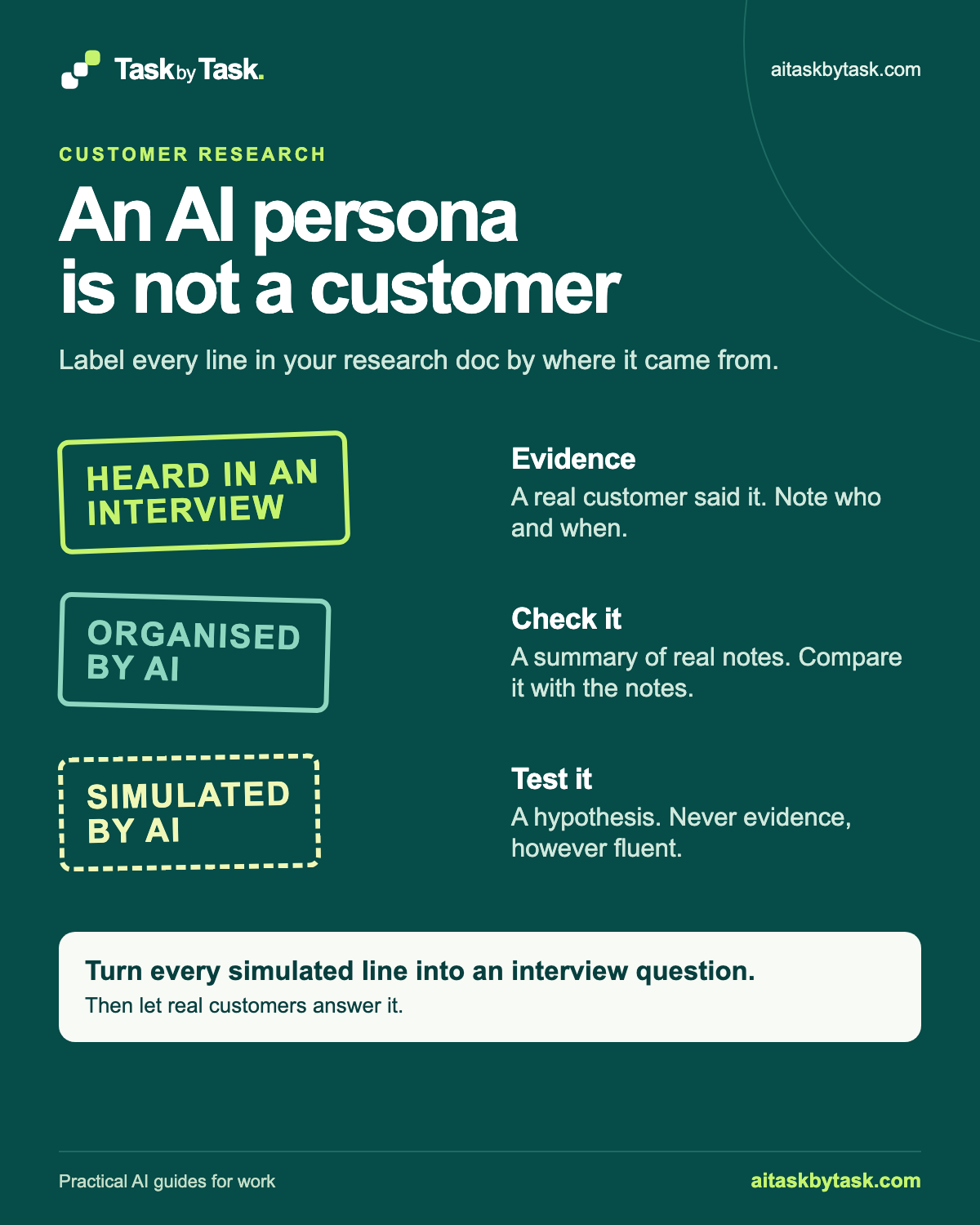
Every line in a research doc should say where it came from. Use these three labels, and nothing gets in without one.
| Label | What it means | How to treat it |
|---|---|---|
| HEARD IN AN INTERVIEW | What a real customer said, with a note of who (a participant code) and when | Evidence. Quote it accurately; do not tidy the meaning. |
| ORGANISED BY AI | A summary, theme or grouping made from real notes | Useful, but check it against the notes before relying on it. |
| SIMULATED BY AI | Anything a persona or brainstorm produced | A hypothesis to test. Never evidence, however convincing it sounds. |
The labels matter most when a doc gets passed around. A simulated line that loses its label in a slide deck becomes “customers say” by the following Tuesday, so keep the label on the line itself.
Why this works: A label attached to the line survives being copied into another document.
What you should see: Evidence, summaries and simulated hypotheses visibly separated.
2. Ask AI to draft your interview questions
This is one of the most useful jobs AI can do here, and it needs no customer data. Describe what you are trying to learn and ask for questions about what people actually did recently. A customer describing last Tuesday gives you something to check; a customer predicting what they might buy one day gives you a guess.
I am preparing customer interviews for [product or idea].
The people I will interview are [type of customer and their role].
I want to learn [the decision or problem you are trying to understand].

Draft 8 interview questions. Ask about specific recent experiences
("Tell me about the last time...") rather than opinions or predictions.
Avoid leading questions and avoid mentioning our product or solution
until the final question.

For each question, add one neutral follow-up prompt.
Then list any question that combines two topics, so I can split it.
Replace [product or idea], [type of customer and their role], [the decision or problem you are trying to understand] with the corresponding detail or notes from your own task.
Read the draft as the interviewee would. Remove anything that hints at the answer you want (“How frustrating is it when…”), and cut questions you would not use the answer from. If you are also sending a survey, improve a survey before you send it uses the same checks for leading wording.
Why this works: Questions about a recent event give you an experience to examine.
What you should see: Eight neutral questions, each with one follow-up and any double question marked.
3. Organise your real notes, then check the organiser
After interviews, AI can group notes into themes with supporting quotes. Before you paste anything, treat interview notes as personal data: they relate to identifiable people, and a job title plus a company size can identify someone even without a name. Use notes only where your organisation has established the lawful basis and explained their use to participants, including any consent it requires, and only in an account it approves for this kind of material, and with the minimum detail the job needs. Replace names with participant codes and leave out anything the analysis does not need.
Below are interview notes from [number] customer interviews.
Each block starts with a participant code and the interview date.

Group the notes into themes. For each theme:
- give a one-line description
- list the participant codes that support it
- include one or two exact quotes, copied word for word, with the code
- note any participant who said something that contradicts the theme

Use only the notes below. Do not add themes, reasons or customer
types that are not in them. If a theme rests on one participant,
say so. Label every theme ORGANISED BY AI.

[Paste permitted notes with participant codes]
Replace [number], [Paste permitted notes with participant codes] with the corresponding detail or notes from your own task.
Then check it. Find each quote in the original notes and confirm the words and the participant code. Look at which participants support each theme; a theme backed by one person is a lead, not a pattern. Read the contradictions section: if it is empty and your notes were not unanimous, ask again. The survey themes guide and the customer call guide go further on counting and tracing.
A common failure is the smoothed quote, where “it is a bit of a faff on Mondays” becomes “customers find weekly scheduling difficult”. Ask for the exact words and code, then compare them with the original. The final check below repairs a related mistake: grouping a participant under the wrong reason.
Why this works: Codes and exact quotes let you check a theme against the interviews.
What you should see: Themes supported by identifiable note entries, with contradictory participants named.
4. Use a persona for hypotheses, labelled as such
A simulated customer can still earn its keep: generating objections you had not considered, stress-testing your questions, or suggesting what might matter to a segment you have not reached yet. Ask for that explicitly, and ask for the output in a form that keeps its status visible.
Act as a simulated [type of customer]. You are not a real customer
and your answers are not evidence.

Give me 5 hypotheses about [the problem or decision] that real
interviews could test. Label each one SIMULATED BY AI.
For each hypothesis, write one open interview question about a
specific past experience that could support or contradict it,
without suggesting the answer.
Replace [type of customer], [the problem or decision] with the corresponding detail or notes from your own task.
The persona’s confidence is a property of the writing. Convenient detail and enthusiasm for your roadmap tell you nothing about what a real customer would say.
Why this works: Calling the output a hypothesis prevents a fluent persona becoming evidence.
What you should see: Five simulated lines, each paired with an open question for a real interview.
5. Turn simulated lines into a validation plan
Collect every SIMULATED BY AI line into one plan. For each, write the question you will ask, who you need to ask, and what you would accept as support or contradiction before you hear the answer. Deciding that in advance makes it harder to read every reply as a yes.
After the interviews, change the label only when real evidence arrives: add the HEARD IN AN INTERVIEW lines underneath, mark the hypothesis supported, contradicted or still open, and leave the original simulated line in place so the history is visible. Whether the evidence is enough to change a product, a price or a promise to customers is a decision for the people responsible, not for the persona or the summary.
Here is the interview-and-evidence template:
RESEARCH QUESTION:
DECISION THIS WILL INFORM:
DECISION OWNER:

HANDLING AND PARTICIPANT INFORMATION
Lawful basis confirmed by:
Participants told about:
Any required consent covers: [recording / notes / use in approved AI account]
Approved account used:
Notes stored at:
Delete or review by:

INTERVIEW LOG
Repeat one interview record per participant:
Code:
Date:
Customer type, without names:
Interviewer:
Participant information and any required consent: recorded? (Y/N)

EVIDENCE LINES
[HEARD IN AN INTERVIEW] Code, date: "exact words"
[ORGANISED BY AI] Theme: ... | Codes: ... | Checked against notes by ... on ...
[SIMULATED BY AI] Hypothesis: ...

VALIDATION PLAN
Hypothesis (SIMULATED BY AI):
Question to ask:
Who to ask:
Would support it:
Would contradict it:
Status after interviews: supported / contradicted / still open
Evidence lines (codes and dates):
Why this works: Deciding what would contradict a hypothesis reduces the temptation to count every reply as support.
What you should see: A validation entry for every simulated line, with a decision owner and next interview question.
Check the result
- Each evidence line has its source label, code and date where relevant.
- Interview quotes match the original notes exactly.
- Themes show which participants support them and any contradictions.
- Every simulated claim remains a hypothesis with a question to test it.
The usual failure: the organiser smooths different reasons into one theme or rewrites a quote. Find the participant’s original words before accepting it.
The theme describes C2 as complaining about last-minute staffing changes. C2's notes
say clients moved their slots. Separate last-minute staffing changes (C1 and C3)
from client rescheduling (C2), with exact quotes and participant codes.
Mark every theme ORGANISED BY AI. Do not strengthen the conclusion.
Worked example: a scheduling app’s persona meets three customers
Fictional example. An invented scheduling app serves small cleaning firms. Its founder asked a chat assistant to play “a cleaning-company owner” and got this answer:
[SIMULATED BY AI] "Honestly, route planning is my biggest headache.
I'd pay more for automatic routes between jobs."
The team had already sketched a route-planning feature. Instead of putting the answer in the pitch deck, they added it to the validation plan with an open question: “Tell me about the last time the day’s plan had to change.” They agreed beforehand that unprompted mentions of travel or routes would support the hypothesis, and other causes of disruption would count against it.
They interviewed three owners, with consent to use pseudonymised notes in the company’s work AI account:
C1, 2 Sept: "A cleaner texts at six saying she can't make today and I'm moving
jobs around on my phone before I've had a coffee."
C2, 4 Sept: "Routes are fine, I know the area. The pain is clients
moving their slot the night before."
C3, 9 Sept: "The bit I hate is reshuffling when a shift is unfilled."
The AI organiser grouped these into one theme, “Same-day changes to who works where”, supported by C1, C2 and C3. The founder checked each quote against the notes and found that the summary had described C2 as complaining about last-minute staffing changes. C2 talked about clients moving slots, which is a different cause. The theme was reworded to “same-day changes from last-minute staffing changes (C1, C3) or client rescheduling (C2)”.
The validation plan entry ended up like this:
Hypothesis [SIMULATED BY AI]: route planning is the biggest headache.
Status: not supported in these three interviews. C2 explicitly said
routes are fine; C1 and C3 named last-minute staffing changes instead. This small
sample does not establish what all customers need.
Next question: how do owners currently handle same-day changes, and
what does a bad morning cost them? Ask in the next round.
Three interviews do not settle the roadmap, and the team said so. But they replaced a fluent guess with a better question, which is the point of the exercise.
Go deeper
You can stop after the checked example. These lessons help when research runs over several rounds.
Audit an existing research doc for missing labels
Many teams already have a persona doc where interview quotes, AI summaries and invented answers sit side by side. Ask the assistant to sort it, then check every line it marks as interview evidence.
Classify every line in the document below as HEARD IN AN INTERVIEW,
ORGANISED BY AI, SIMULATED BY AI or UNKNOWN SOURCE.
Only use HEARD IN AN INTERVIEW where the line includes a participant
code or name and a date. If you are unsure, use UNKNOWN SOURCE.
Do not rewrite the lines.

[Paste the document]
Replace [Paste the document] with the corresponding detail or notes from your own task.
Anything marked UNKNOWN SOURCE goes back to the person who wrote it, or into the validation plan. The assistant cannot know where a line came from; it can only see whether the line says so.
Keep personal data proportionate as the research grows
Each new round adds notes, recordings and summaries. Keep the consent record next to the interview log, and check it before notes go into any new tool, including another AI account. Do not upload a full transcript when the job needs three quotes. Removing a name does not necessarily make notes anonymous: “the only dental practice in town with four sites” identifies someone.
Set a review date for raw notes and recordings, and delete or archive them according to your organisation’s rules. If you are unsure whether a use is covered, ask the person responsible for data protection before uploading, not afterwards.
Use quotes outside the research doc
A quote that supports a theme in your notes is not automatically cleared for a website, a sales deck or a case study. Public use needs the customer’s specific permission for that use and that wording. Turn approved customer quotes into a case-study outline covers that step. SIMULATED BY AI lines should never appear as customer quotes anywhere, including “illustrative” ones in a pitch.
Sources
The ICO’s guidance on what personal data is explains that information relating to a person who can be identified directly or indirectly is personal data, and that pseudonymised data remains personal data. The ICO’s AI guidance provides wider data-protection context. The three-label method and validation plan are an editorial approach, not a legal test or a measured research result.