Make an AI-drafted document sound like your organisation
The draft has the right information, but it sounds like a company you've never worked for: everyone is delighted, everything is seamless, and a routine update has become a journey.
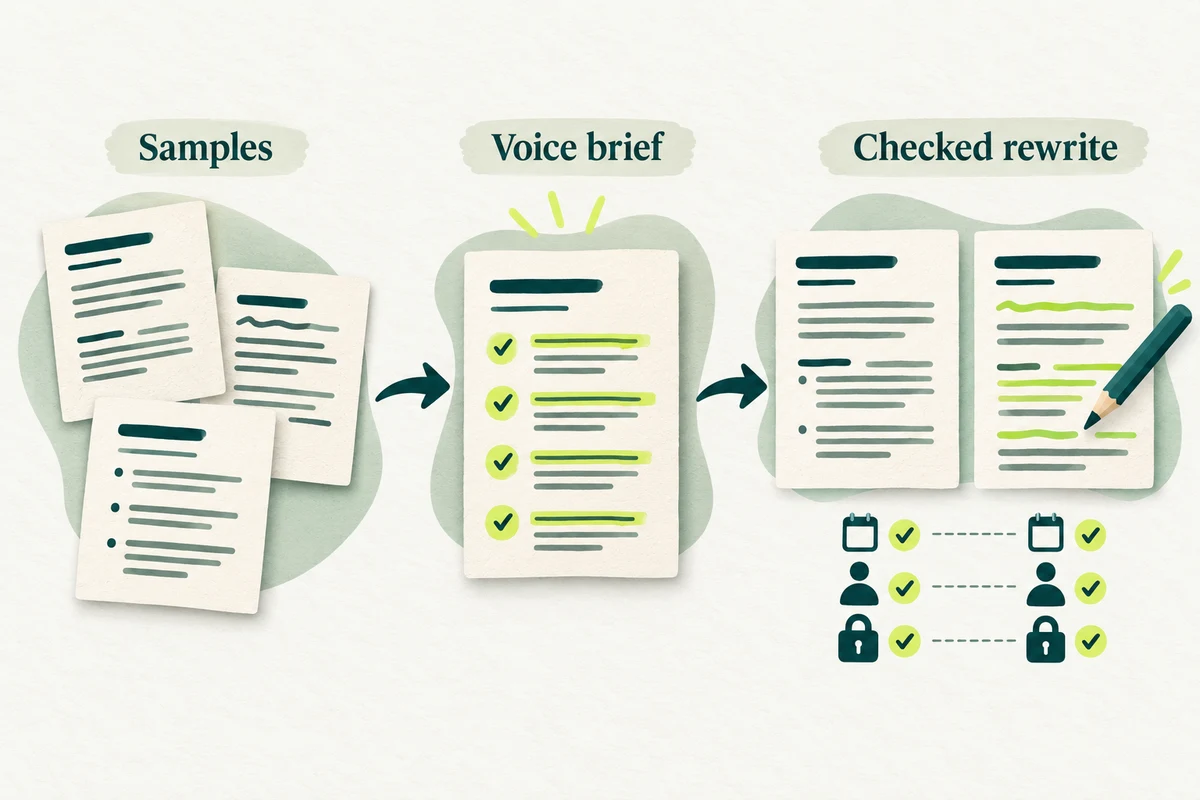
What you'll make
a one-page house voice brief and one rewritten document, checked line by line for changes to its meaning.
What you'll need
a chat in Claude, ChatGPT, Gemini or Copilot through your work account, three short pieces of writing your organisation is happy to reuse, and a draft whose facts you’ve already checked. Allow about 30 minutes the first time.
Example result.
Brief (extract): Start with the change the reader needs to know. Use “we” and “you”. Give the reason in one plain sentence. End with the next action and who owns it.
Rewrite (opening): The new reporting portal will open on 14 November, two weeks later than planned. Testing found a problem with the transfer of historical data. We will fix it before launch.
1. Choose three samples of the writing you want
Pick the same kind of document as the one you’re rewriting: for a customer update, use customer updates. Two or three paragraphs from each are enough. Choose ordinary writing, not the most elaborate launch announcement you can find, and remove details that don’t belong in the AI account.
Then read the three together. If they don’t sound alike, stop. You don’t have a house voice yet; you have three people’s personal styles. That’s a conversation with whoever owns communications, and no prompt will substitute for it.
Why this works: the model can only describe patterns in front of it, so they need to be consistent.
What you should see: three short extracts that a colleague would recognise as the same organisation talking.
2. Ask for rules a reader can see
“Warm, professional and approachable” is the output of almost every voice exercise ever run, and it changes nothing, because any draft can claim to be all three. “Opens with the change the reader needs to know” is different: you can look at a draft and see whether it’s true. Ask for that kind of rule, with a quotation behind each one.
I'm making a short house voice brief for [document type] addressed to [audience]. Read the three writing samples below.

Suggest up to eight observable writing rules. For each, give:
1. The rule in plain language.
2. One exact short quotation from a sample that supports it.
3. Any conflicting evidence in the other samples.

Look at paragraph openings, sentence structure, contractions, we/you/organisation-name wording, requests, explanations of bad news, recurring terms and endings. Describe what you can observe; don't invent a rule because it sounds like good business writing. Don't use adjectives such as warm, professional or engaging as rules. If the samples don't settle a question, mark it for a human decision.

SAMPLE 1
[sample text]

SAMPLE 2
[sample text]

SAMPLE 3
[sample text]
[document type] is the kind of document, such as “customer service update”. [audience] is who reads it. [sample text] is each extract from step 1.
Why this works: quotations let you check the model’s reading, and asking for conflicting evidence exposes a rule that fits one sample but not the other two.
What you should see: up to eight rules, each with a quote you can find word for word in a sample. Reject any quote that’s altered or missing.
3. Turn the suggestions into a one-page brief
Edit the rules yourself, or with whoever owns your writing standards. Add spellings, product names and terms the samples don’t cover, and use any existing style guide to settle disagreements. Three samples won’t settle every rule; mark the rest for a human decision.
HOUSE VOICE — [document type and audience]
Owner and version: [person or team, and date]

OPENING: [What the reader needs first.]
SENTENCES AND PARAGRAPHS: [Structure and length for this document.]
PERSON AND WORDING: [We/you, contractions, preferred terms and spellings.]
REQUESTS AND BAD NEWS: [How to state a request, change or delay.]
AVOID: [Specific phrases, each with a preferred alternative.]
ENDING: [The next action, owner or useful closing information.]
Give alternatives where you can. “Ask the reader to contact their account manager” is more useful than banning “reach out” and leaving the gap.
Why this works: alternatives tell the model what to write, not only what to avoid.
What you should see: one page, with an owner and a date, that a colleague could apply without asking you what it means.
4. Rewrite the wording, then compare the meaning
Check the draft’s facts before this step. A style pass can’t supply a missing decision or repair an unsupported date.
Rewrite the draft for [audience] using the house voice brief below.

Change wording, sentence structure and paragraph shape only. Keep every fact, figure, date, named role, commitment, condition and expression of uncertainty. Add no information. If a voice rule conflicts with keeping the meaning, keep the meaning and explain the conflict after the rewrite. Flag missing information instead of filling it in.

Return the rewritten draft, then a short table of potentially meaningful changes: original wording, new wording and what I should check. Say if you found none.

HOUSE VOICE BRIEF
[your brief]

DRAFT
[the fact-checked draft]
[your brief] is the page from step 3; [the fact-checked draft] is the document you’re rewriting.
Why this works: separating “how it sounds” from “what it says” gives you two small jobs instead of one tangled one, and the change table points you at the risky edits.
What you should see: a rewrite that sounds like your samples, then a change table. The model can miss its own changes, so treat the table as a starting point.
Check the result
- Read the original and the rewrite side by side. Every date, amount and named role is still there.
- Hedges survive: “may”, “aim”, “subject to” and “up to” haven’t been tidied away.
- Each action keeps its owner, its medium and its date together.
The usual failure: a promise quietly changes shape. “We aim to respond within two days” becomes “we respond within two days”, or “confirm the arrangements in writing” becomes “confirm the date”. The sentence reads better and means something else. Spot it by checking every verb attached to a person or a date.
In your rewrite, "[new wording]" changes the meaning of the original "[original wording]". Restore the original meaning, keeping the voice brief's style. Change nothing else, and list any other places where an action, owner, date or condition differs from the original.If you can’t tell what the original meant, ask its owner. A polished uncertainty is still an uncertainty.
Worked example: a delayed portal update
Fictional example. A small services firm wants a customer update in its usual plain style. Its three samples (a report notice, a support-hours change and a delay notice) all open with the news, use “we” and “you”, give one plain reason and end with the next action. None uses contractions, so the editor decides to avoid them in this brief. That’s a choice based on limited evidence, not a universal house rule.
We are delighted to share an important update regarding your reporting portal. The new portal will open on 14 November, two weeks later than planned. Testing identified a problem with the transfer of historical data, and we will fix it before launch.

In order to support a seamless transition going forward, your existing reports will continue unchanged until the new portal opens. You do not need to take any action. Your account manager will confirm the launch arrangements in writing on 20 October.
The first rewrite was better in tone and wrong in one line. Weak: “Your account manager will confirm the launch date on 20 October.” The change table didn’t flag it. After the repair prompt, with “the launch date” as the new wording and “the launch arrangements in writing” as the original, the update reads:
The new reporting portal will open on 14 November, two weeks later than planned. Testing found a problem with the transfer of historical data. We will fix it before launch.
Your existing reports will continue unchanged until the new portal opens. You do not need to take any action. Your account manager will confirm the launch arrangements in writing on 20 October.
| Check | Original and rewrite |
|---|---|
| Opening date and delay | 14 November; two weeks later than planned |
| Problem and commitment | Historical-data transfer; fix before launch |
| Customer action | None needed; reports unchanged |
| Owner, action and date | Account manager confirms launch arrangements in writing, 20 October |
- The news moved up: the customer reads the date before any reassurance, as the brief’s opening rule says.
- The padding went, the facts stayed: “delighted” and “seamless transition” add no information, so removing them changes nothing the customer relies on.
- The narrowed promise was caught by reading, not by the table: “the launch date” is a smaller commitment than “launch arrangements in writing”. Checking the verb attached to the account manager found it.
Try it
Compare a tone request with a meaning-preserving voice brief
Example responses, written to show what each prompt tends to produce.
Weak: Sound professional
The prompt
Make this update sound professional.

Update notes: opens 14 November, two weeks late due to historical-data transfer; fix before launch; existing reports unchanged; customers need take no action; account manager confirms launch arrangements in writing 20 October. House voice starts with the news and uses plain we/you wording.
Example response
Select a phrase in the response to inspect its support or weakness.
Why this prompt changes the task
A style adjective leaves many choices open and cannot protect the precise promise.
Plain and short
The prompt
Use plain we/you wording. Start with the opening date and keep the update brief.

Update notes: opens 14 November, two weeks late due to historical-data transfer; fix before launch; existing reports unchanged; customers need take no action; account manager confirms launch arrangements in writing 20 October. House voice starts with the news and uses plain we/you wording.
Example response
Select a phrase in the response to inspect its support or weakness.
Why this prompt changes the task
Clearer structure can coexist with a changed action. Compare semantic details, not fluency alone.
Approved voice and fixed meaning
The prompt
Start with the news, use we/you and a plain reason. Remove promotional padding. Preserve all dates, delay, data-transfer issue, fix commitment, unchanged reports, no customer action, and account manager’s written launch-arrangements confirmation. Use the source only.

Update notes: opens 14 November, two weeks late due to historical-data transfer; fix before launch; existing reports unchanged; customers need take no action; account manager confirms launch arrangements in writing 20 October. House voice starts with the news and uses plain we/you wording.
Example response
Select a phrase in the response to inspect its support or weakness.
Why this prompt changes the task
Observable voice choices and a fixed-facts list guide different aspects of the rewrite. Neither replaces source review.
Task kit for this job: Download (ZIP) · Reusable instructions
Go deeper
Learn from edits you've already made
Before-and-after pairs show habits your editors keep removing. Review the suggestions before adding them to the brief; an edit made for one situation may not belong in every document.
Compare the original draft and the edited version below. List recurring wording or structure changes, each with an exact before-and-after quotation. Separate changes of style from changes of fact or meaning. Suggest which style changes might belong in our voice brief and which need a human decision.

ORIGINAL DRAFT
[original text]

EDITED VERSION
[edited text]
Give each new rule a reason and an alternative, and keep factual corrections out of the style rules.
Keep one current version of the brief
Save the brief alongside your existing writing guidance, with an owner and a version date, and paste the current version into each new task. That gives colleagues a shared source without relying on any product’s saved-instructions feature. When a rule changes, update the source first. Keep separate briefs where the writing differs: a complaint response and a launch announcement need different choices, even from the same organisation.
Work through a long document in sections
If the document is too long to compare comfortably, rewrite one section at a time with the same brief, then read the whole thing for repeated openings, inconsistent terms and contradictions between sections. When the facts are right but one paragraph still sounds wrong, name the problem precisely (“replace ‘reach out’ with ‘contact your account manager’”) and ask for a revision of that paragraph only. Read for purpose as well as style: a sentence can follow the brief and still tell the reader nothing they need. For enforcing terms and spellings inside Grammarly, see the house style guide post.